
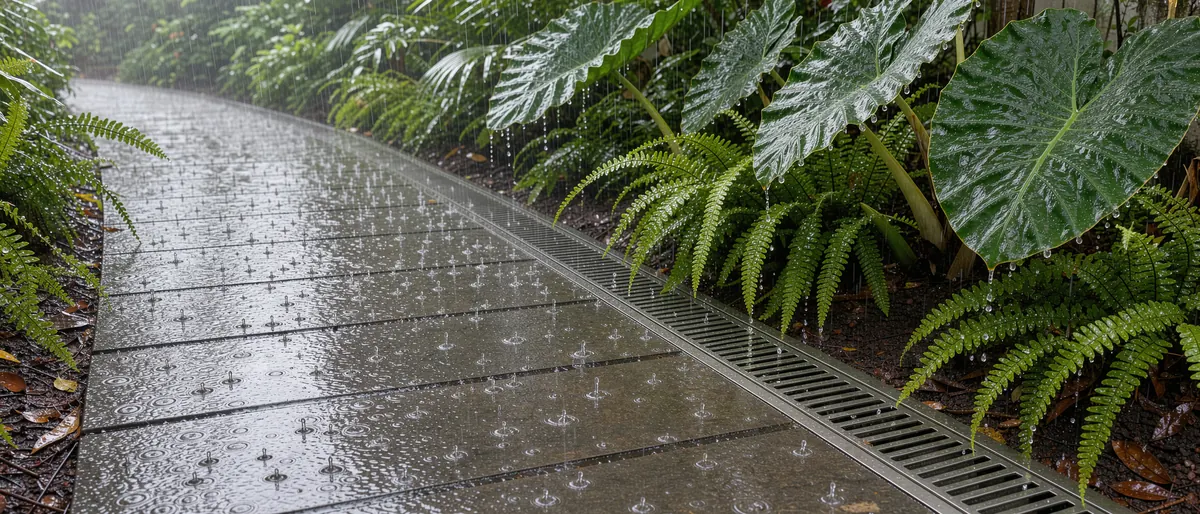
Short answer: For Mumbai's monsoon, the surface finish matters more than the stone. Flamed or bush-hammered granite, leather- or rough-finish Kota and dressed basalt all keep their grip when wet. Avoid polished stone outdoors, seal porous stones, and lay every paved surface to a fall towards a drain.
Finishes first
The same stone can be safe or dangerous when wet, depending on how its surface is finished. Polished and honed surfaces are smooth and become slippery in rain. Textured finishes keep grip: flamed (the surface is heated until crystals pop, leaving a rough texture, used on granite), bush-hammered (pitted with a hammer head), leather (a soft, slightly textured matte finish) and rough-cut or natural cleft surfaces.
The stones compared
| Stone | Character | Outdoors in the monsoon |
|---|---|---|
| Kota (limestone, Rajasthan) | Grey-green or brown, even, economical | Good in leather or rough finish; seal against stains |
| Granite | Very hard, many colours | Excellent when flamed or bush-hammered; slippery when polished |
| Basalt (Deccan stone) | Dark, dense, local to Maharashtra | Excellent dressed or rough-cut; ideal for steps and walls |
| Sandstone (for example Dholpur) | Warm buff and pink tones | Good grip, but porous: seal it and expect algae in deep shade |
| Kadappa (black limestone, Andhra Pradesh) | Black, smooth, often polished | Use only leather or rough finishes outside; polished is slippery |
| Concrete pavers | Uniform, economical, many shapes | Good grip; permeable types let rain soak through |
Falls and drainage
Every paved surface should slope gently, typically by about 1 in 60 to 1 in 100, towards a drain, a planting bed or open ground, and always away from buildings. Long paths and courtyards need channel drains or gully outlets; edges against lawns and beds need a detail that stops soil washing onto the stone. In Mumbai's heaviest downpours, a surface that sheds water quickly is a surface that stays clean and safe.
What goes underneath
Paving is only as good as its base. That means excavating to firm ground, compacting, laying a sub-base and then a bedding layer, with movement joints in larger areas. This is also the moment to lay sleeves for irrigation pipes and conduits for garden lighting, so they never have to be dug in later.
Sealing and cleaning
Porous stones such as Kota and sandstone benefit from a breathable sealer that resists stains and slows algae. Re-seal every few years, depending on wear. Before each monsoon, clear drains and joints; after it, a gentle wash removes algae and silt. Avoid acid cleaners on limestone such as Kota and Kadappa, which they etch.
Terraces and podiums
On roofs and podiums the paving sits on the building's waterproofing. The membrane needs protecting during work, outlets must stay accessible, and the build-up's weight has to be checked by a structural engineer. Pedestal-mounted paving and lighter bedding are common answers where weight or drainage is tight.
Planning paving, steps or a deck? See our hardscape service.
Questions
Is Kota stone slippery when wet?
Polished Kota can be. Outdoors, choose a leather or rough finish, which gives much better grip in the rain.
What is the best stone for outdoor steps in Mumbai?
Flamed granite and dressed basalt are both excellent: hard-wearing, with a textured surface that grips when wet.
Should outdoor stone be sealed?
Porous stones such as Kota and sandstone benefit from a breathable sealer against stains and algae. Dense stones such as granite and basalt usually need little or none.