
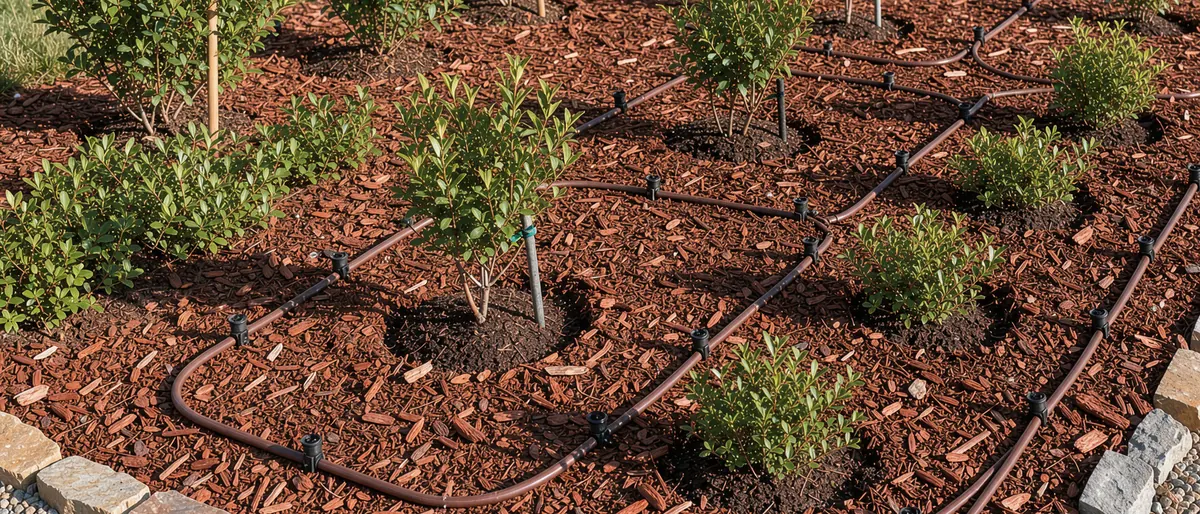
Short answer: Use drip for beds, hedges, planters and trees, sprinklers for lawns, and misting for orchids and ferns. Most gardens need a mix, run as separate zones from one controller. Drip is the most water-efficient because it wets only the root zone; sprinklers give the even coverage a lawn needs.
How each method works
Drip delivers water slowly through emitters, either built into a line (inline drip) or fitted where needed (online emitters and micro-tubes). It wets the root zone and little else. Sprinklers throw water over an area: pop-up sprays cover small lawns, and rotors throw further for larger ones. Misting sprays very fine droplets to raise humidity, which orchids, ferns and propagation areas enjoy.
Side by side
| Drip | Sprinklers | Misting | |
|---|---|---|---|
| Best for | Beds, hedges, planters, trees | Lawns, dense groundcover | Orchids, ferns, shade houses |
| Water efficiency | Highest; little evaporation or run-off | Good if laid head-to-head and run early | Low volume; raises humidity rather than soaking soil |
| Visible? | Hidden under mulch | Heads pop up when running | Fine nozzles above plants |
| Filtration | Fine (typically 120 mesh) | Coarser screen is usually enough | Fine, with clean or softened water |
| Main risk | Clogged emitters from hard water | Wind drift; spray on walls and paving | Mineral spots on leaves |
Typical application efficiencies quoted for well-designed systems are around 90% for drip and roughly 70–80% for sprinklers, which is why drip is the default for everything except lawns.
Zoning
A zone is a group of outlets that run together from one valve. Plants with different needs should never share a zone: a lawn, a shaded fern bed and a sunny terrace planter each need different amounts of water at different times. Typical zones are lawn sprinklers, sunny beds, shaded beds, planters and an orchid misting line. Each gets its own run time and frequency.
Water quality and filtration
Much Indian garden water comes from borewells, tankers or society tanks, and is often hard. Dissolved minerals and fine sand block drip emitters and misting nozzles over time. A disc or screen filter at the head of each system, pressure-compensating emitters and regular flushing of line ends keep things running. Where pressure is low, as on upper-floor terraces fed from a tank, a small booster pump makes a big difference to even watering.
Automation and sensors
A controller opens each zone's valve on a schedule. Wi-Fi controllers can be adjusted from a phone, and many can adjust schedules to the weather. A rain sensor or soil-moisture sensor stops the system watering ground that is already wet, which matters in a city with a four-month monsoon. Fertigation, feeding plants through the irrigation water, is a useful add-on for planters and orchids.
Keeping it working
- Clean filters regularly, more often where water is hard or sandy.
- Flush drip lines from the ends a few times a year.
- Walk the system while it runs: look for dry patches, puddles, tilted heads and spray hitting walls or paving.
- Change the schedule with the seasons: rest it in the monsoon, step it up in April and May.
- Keep an as-built layout so valves and pipes can be found when a garden is replanted or paving is lifted.
Want a system designed with your planting? See our irrigation service.
Questions
Is drip irrigation suitable for lawns?
Subsurface drip can water lawns, but it is harder to inspect and repair. For most lawns, pop-up sprays or rotors laid out head-to-head give the even coverage grass needs.
How long should a drip zone run?
It depends on emitter flow, soil, plant size and season. Zones are set during testing and adjusted as the weather changes, usually running longer and more often in April and May.
Can one controller run drip, sprinklers and misting?
Yes. A multi-zone controller runs each method as a separate zone with its own schedule.